Jack Blog
April 30th, 2026
 Sustainability used to be a signal. Now it’s a test.
For years, brands treated sustainability as something to spotlight, a line in a press release, a moment on stage, a badge to be seen. But audiences have moved on. They’re no longer asking if a brand is talking about sustainability. They’re asking whether it’s real, whether it’s consistent, and whether it holds up beyond the moment.
Because the truth is, visibility is easy. Proof is harder.
Live experiences make that gap impossible to ignore. Events are complex, living systems, shaped by energy, materials, travel, food, and people, all coming together at scale. Every decision leaves a mark. And as the industry begins to measure what was once invisible, the impact is no longer abstract. It’s tangible, trackable, and increasingly expected to be addressed.
That shift is changing the role sustainability plays in experience design. It’s no longer a layer added at the end. It’s becoming a set of choices made from the very beginning, often in ways audiences never see.
And that’s exactly the point.
Less storytelling. More evidence.
There’s a growing tension between what brands say and what they can prove. Audiences have learned to recognize the signals, and they’re paying closer attention to what sits behind them.
Real trust is built differently. It comes from decisions that hold up under scrutiny:
- Choosing venues powered by renewable energy, even when it’s less convenient
- Designing builds for reuse, not just for impact
- Sourcing locally to reduce freight and support host communities
- Rethinking travel, who needs to be there, and how people show up
- Measuring impact, even when the results aren’t perfect
These aren’t headline moments. They’re operational ones. But collectively, they carry more weight than any sustainability claim ever could.
Because trust isn’t built on what’s said once. It’s built on what’s done consistently.
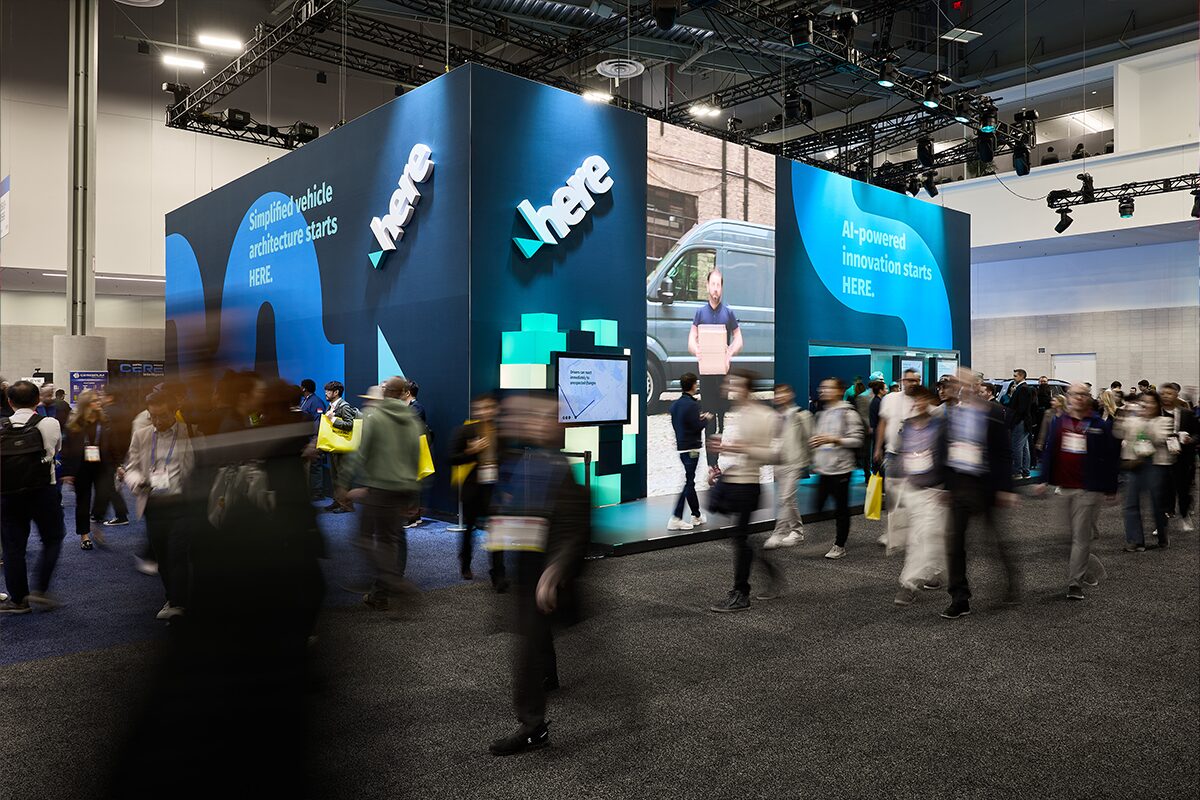
A clear example of this in action comes from HERE Technologies at CES. Instead of treating sustainability as a message, they treated it as a design principle. Their exhibit was built on a fully reusable, modular system, designed to be reconfigured year after year rather than discarded. Materials were selected for reuse and recyclability, components were repurposed across environments, and even content units were designed to live beyond the show floor.
The result wasn’t just a lower-impact footprint. It was a system built to evolve, reducing waste, limiting transport needs, and proving that sustainability can be embedded without compromising the experience itself.
The shift from intention to integration
Across the industry, sustainability is no longer a side conversation. It’s becoming part of how experiences are evaluated, designed, and delivered.
That shift shows up in the questions being asked earlier in the process. Not just what will this experience look like, but what will it require, what will it leave behind, and who does it impact along the way.
It also shows up in how success is defined.
Scale and spectacle still matter. Presence still matters. But they can’t exist without responsibility.
And while not every factor is fully within control, many are.
Material choices. Energy use. Food and sourcing. Waste. Partnerships. These are the levers that turn sustainability from a promise into a practice.
Designing for what happens after
One of the most telling shifts is happening at the end of the process, or more accurately, at the beginning.
More teams are starting by asking what happens after the event is over. Where materials go. What gets reused. What gets discarded. What impact lingers in the host community long after the experience ends.
That perspective changes everything.
It reframes sustainability from something to manage into something to design for. It challenges teams to think beyond the moment and consider the full lifecycle of an experience, from first sketch to final breakdown.
Why restraint is becoming a strategy
There’s a quiet shift happening in how leading brands approach sustainability communications.
They’re saying less. And doing more.
Not because sustainability matters less, but because it matters more. Enough to know that over-claiming can erode the very trust they’re trying to build.
Instead of spotlighting every initiative, they’re focusing on embedding sustainability into the experience itself. Making it visible where it needs to be, and invisible where it doesn’t. Letting the work speak through consistency, not amplification.
It’s a different kind of confidence. One that prioritizes credibility over attention.
What comes next
Sustainability in live experiences isn’t about perfection. It’s about progress that can be seen, measured, and repeated.
The brands that will lead aren’t the ones making the biggest claims. They’re the ones making the clearest commitments, and backing them up through action.
Because in a landscape where everyone is saying the right things, trust belongs to the brands that can back it up with actions people can see and believe.